Leg Bindings (Men)
...
Viking Age Compendium articles on Men's Clothing:
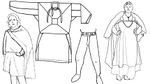

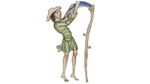

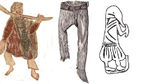
Leg Bindings
Art
--
Literature
--
Archaeology
- York, lichen purple (PRITCHARD 1984 p.68)
- London, Lichen purple, 2 of indigotin (woad blue) (PRITCHARD 1984 p.68)
- Elisenhof, Germany (8thC): The remains of 17 leg bindings were found. 15 were made of 2/2 chevron twill, 2 were made of 2/1 chevron twill. The width's are between 7.3cm and 9.8cm. (HUNDT 1981 p.47) (PRITCHARD 1984 p.68)
- Dublin, 1 of different warp to weft (PRITCHARD 1984 p.68)
- Hedeby Harbour, Germany: 5 fragments of leg bindings were found in Hedeby harbour (HAGG 1984 p.24)
- Fragment 28: This is part of a sleeve, where an old leg binding may have been reused as part of the sleeve. It is a self woven band of 2/2 twill and is 7.5cm wide.
- Fragment 29: Fragmentary piece of tabby with cut and hemmed edges, probably a leg binding as it is the right width (7.5 cm)
- Fragment 43: Self woven band in 2/2 twill, 102 cm long and 7.5 cm wide.
- Fragment 49B: Fragmentary self woven band in chevron twill. 42cm long and 9cm wide. (HAGG 1984 p.24)
- Fragment 55C: Self woven band in chevron twill. 118cm long and 8.5cm wide. (HAGG 1984 p.28)
- Hedey Settlement, Germany: Two fragments of leg bindings were found in the settlement of Hedeby (HAGG 1991 p.32)
- Fragment S26: Self woven band of 2/2 chevron twill. 41cm long and 7-8cm wide.
- Fragment S34:Self woven band of diamond weave. 58cm long and 11cm wide.(HAGG 1991 p.32)
Discussion
--
Cross Gartering
This style became popular in the 11th Century and continues xxxxxx.
Art
The earliest Anglo-Saxon manuscript to depict cross gartering is the Cotton Tiberius C VI dated to c.1050AD.
Literature
--
Archaeology
Discussion
--
Wrapped around the foot
Art
- Harley Psalter fol.1v (OWEN-CROCKER 1976 p.489). I think there is a typo in her book as it references fol. 27v (OWEN-CROCKER 2004 p.257) which shows no seated figure.
Literature
--
Archaeology
Discussion
--
Fastening leg bindings
It appears that most leg bindings were simply tucked in to secure them although a number of other options may have been used such as cords, and garters.
With hooked tags
Art
--
Literature
--
Archaeology
- Birka, Sweden, grave Bj903, a pair of bronze hooks in situ under the kneecaps of a male skeleton. 10th cent. (ARBMAN 1940). The hooks were fastened into small iron rings, to which linen tabby possibly from the trousers was rusted (HAGG 1986)
- Novgorod , A bronze hook, C9-10th. (NOSOV 1987).
- Winchester, England, a pair of small silver hooked tags found below the knee, C9th. (BIDDLE 1990).
Discussion
Biddle suggests that a better use for such hooks is to hold together two edges of a garment. For instance, they could have been used to fasten a split in the upper edge of a short stocking, allowing it to fit snugly to the calf. (BEATSON-B)
For more information regarding garment hooks see Accessories – Fasteners
Cloth garters and ties
Art
- 'Benedictional of St. Aethelwold', Anglo-Saxon 971-984AD. The three Magi have tassels or tags on the ends of the garters or ties.
Literature
--
Archaeology
- Denmark, Daugbjerg. As seen on the Daugbjerg bog body (xxxC) simple cords may have been used to hold up the leg bindings (OWEN-CROCKER 2004 p.118) (CROOM 2000 p.57-58)
- Denmark, Søgård Mose. (CROOM 2000)
- Finland. Narrow tablet woven garters were used by Viking Age Finns to fasten their chevron twill puttees (KHVOSCHCHINSKAIA 1992), the garters often had plaited terminals interlaced with coils of bronze wire a particularly Baltic embellishment
- Norway, Skjoldenhamn. c.1024AD. Tablet woven ankle band (LOVLID 2009)
Discussion
--
Leather garters
A pair of leather straps complete with buckles, metal strap retainer loops and strap ends worn just below the knee.
Art
--
Literature
--
Archaeology
- Lejre, Denmark, 3 finds. Bronze and iron. c.900AD (BEATSON-B)
Discussion
A rare left over from the popular Germanic aristocratic fashion from the Merovingian period. (BEATSON-B)


