Pins
...
Viking Age Compendium articles on Rings & Pins
Introduction
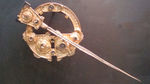
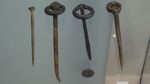
Pins were probably the most common form of cloak fastening in the Viking Age (GRAHAM-CAMPBELL 1980 p.30)
Pins classed as dress pins could have been used for a number of purposes including fastening cloaks, securing hair styles or as stylus. (MACGREGOR, MAINMAN & ROGERS 1999 p.1949).
(OWEN-CROCKER 2004)
Morris makes the point that wooden pins would not have had the strength of pins made from other materials but would have been quicker and easier to make. (MORRIS 2000 p.2309)
Hinton points out that there are 'practically' no small dress items made of precious metals after the C10th (HINTON 2005 p.166).
Heads
The typology styles 1 to 6 are based on that by Nicola Rogers (ROGERS 2009 p.33). Styles 7 to 15 have been added by the author. The Irish-sea corpus is usually classified using O'Rahilly's typology (O'RAHILLY 1973) summarised by Nicholson and Hill (NICHOLSON & HILL 1997 p.365). Both types are included in italics under each heading.
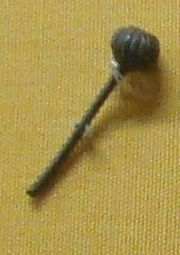
1: Globular (spherical, ball)
Rogers - Type 1; O'Rahilly - Type a (Round)
Archaeology
- England York
- 6 of iron. 2 with pellets attached to the globular heads (OTTAWAY 1992 p.693-695)
- 14 of bone (MACGREGOR, MAINMAN & ROGERS 1999 p.1948-1949)
- England Flixborough
- 78 of copper alloy (EVANS & LOVELUCK 2009 p.33)
- 10 of silver (EVANS & LOVELUCK 2009 p.70-72)
- 33 of iron. 12 with lead heads, 2 with glass heads, 19 with iron heads (EVANS & LOVELUCK 2009 p.74-77)
- Scotland Ballinaby, Islay. silver ball headed pin in a woman's grave. (HINTON 2005 p.124)
Discussion
Originate in the early Anglo-Saxon period (OTTAWAY 1992 p.693). A long lived type – impossible to separate roman from post roman on typology (MACGREGOR, MAINMAN & ROGERS 1999 p.1950). The Flixborough examples date from AD 650-1000.
-
 Type: Globular
-

-
 Kings Lynn


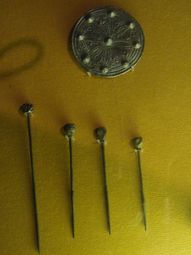
2: Polyhedral
Rogers - Type 2
Archaeology
- England York
- 2 of iron [OTTAWAY 1992: p.693]
- 1 of wood [MORRIS 2000: p.2309]
- England Flixbourgh
- 66 of copper alloy [EVANS & LOVELUCK 2009: p.33]
- 1 of silver [EVANS & LOVELUCK 2009: p.70-72]
- 17 of iron [EVANS & LOVELUCK 2009: p.74-75]
- Ireland, Lagore Crannog, 1 of wood
- Iceland, Hafurbjarnarstađir. 15cm long silver pin. (HAYEUR SMITH 2003 p.143-175 cst.13667)
Discussion
Originate in the middle Anglo-Saxon period (OTTAWAY 1992 p.693)
-
 Type 2 Polyhedral
-
 York


3: Biconical
Rogers - Type 3; O'Rahilly - Type g (Club)
Archaeology
- England Flixbourgh
- 79 of copper alloy (EVANS & LOVELUCK 2009 p.33)
- 20 of iron (EVANS & LOVELUCK 2009 p.76-77)
Discussion
--

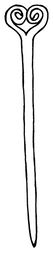
4: Spiral (Bifurcated)
Rogers - Type 4
Archaeology
- England Flixbourgh
- 14 of copper alloy (EVANS & LOVELUCK 2009 p.33)
Discussion
--
-
 Type: Spiral
-
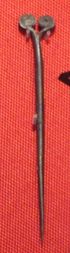


5: Headless
Rogers - Type 5; O'Rahilly - Type e (Undifferentiated)
Archaeology
- England York
- York, 2 finds of iron (OTTAWAY 1992 p.695, Cat.3807,3810)
- England Flixbourgh
- 67 of copper alloy (EVANS & LOVELUCK 2009 p.33)
Discussion
--

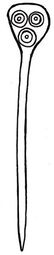
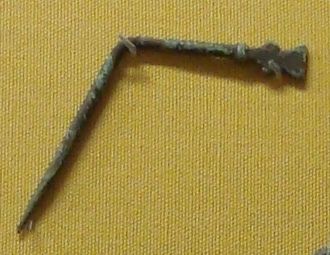
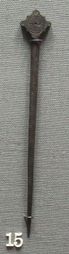
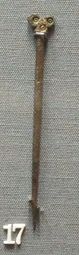
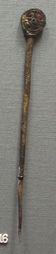
6: Flat (disc, trapezoid or conical)
Rogers - Types 6 (Disc), 7 (Triangular) & 8 (inverted conical); O'Rahilly - Types b (Squared), c (Disc), d (Rounded)
Archaeology
- England York
- 2 finds of iron with spirally twisted shanks (OTTAWAY 1992 p.696, cat.3804,3809)
- 1 find of bone, disk shaped, late C10th.
- England Flixbourgh
- 18 of copper alloy Types 6 & 7 (EVANS & LOVELUCK 2009 p.33)
- 1 of silver - disc shaped (EVANS & LOVELUCK 2009 p.70-72)
Discussion
--
-
 Type: Flat
-
 Type: Flat
-
-
-
-


7: Flat perforated head
Pins that have perforated heads much in the same manner as a needle but have heads that are deemed to be too large to pass through cloth.
Archaeology
- England York
- 2 finds of iron (OTTAWAY 1992 p.695 Cat.3808,3812)
- 13 of bone, 2 of antler (MACGREGOR, MAINMAN & ROGERS 1999 p.1951)
Discussion
--
8: Linked
Rogers - Type LIN1, LIN2
Archaeology
- Scotland
- Whithorn, 2 of Copper-alloy (NICHOLSON & HILL 1997 p.369 nos.4 & 5)
Discussion
--
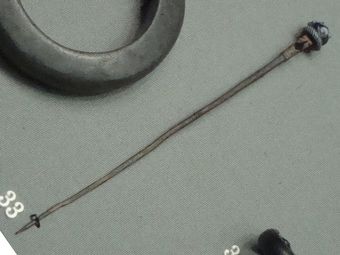
9: Miscellaneous
Archaeology
- -
- -
Discussion
--
-
 Drumiller Ireland
-
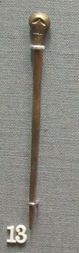 Dublin


10: Pig fibulae
Rogers - Type B2
...... including pins that have perforated heads much in the same manner as a needle but have heads that are deemed to be too large to pass through cloth.
Archaeology
- England York
- York, 61 finds of perforated pig fibulae and 10 finds of unperforated pig fibulae (MACGREGOR, MAINMAN & ROGERS 1999 p.1950)
- Flixborough, 8 finds (ROGERS 2009 p.39-40)
Discussion
Many more could be included from York if bone needles with smaller heads were to be included.
-
 Type: Pig Fibulae
-
 Dublin


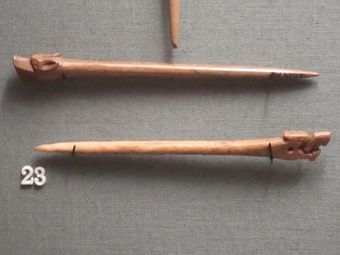
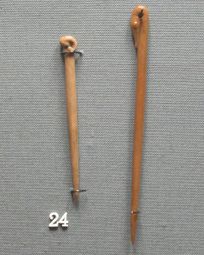
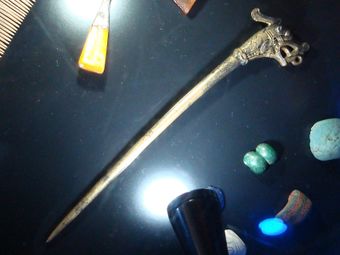
11: Zoomorphic
Archaeology
- England, York, 5 finds, 1 of bone, 4 of unknown. (MACGREGOR, MAINMAN & ROGERS 1999 p.1949)
- Scotland, Jarlshof. 4 completed bone pins with dragon head aligned to the shaft with open mouths and two part made pins. (MACGREGOR 1985 p.119)(MACGREGOR, MAINMAN & ROGERS 1999 p.1949)(HAYEUR SMITH 2003 p.173).
- Iceland, Ymaberg. Bone, dragon head with open mouth, 16.3cm long (HAYEUR SMITH 2003 p.173 cat.11296).
- Denmark, Hedeby.
- Frisian
- Scandinavia, 6 finds
- Flixbourgh, 4 of silver (EVANS & LOVELUCK 2009 p.70-72)
Discussion
Dated to the 9th or 10th century but may have continued into the 12th in Sweden (MACGREGOR, MAINMAN & ROGERS 1999 p.1949).
MacGregor notes that the pins found at Jarlshof must have been made in a local workshop (MACGREGOR 2005 p.119)
-
 Type: Zoomorphic
-
 Dublin
-
 Dublin
-
 Dublin
-
 Hedeby


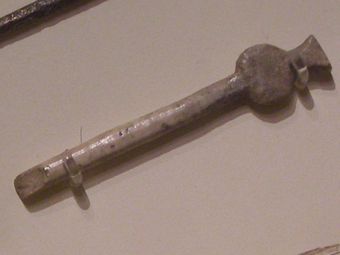
12: Shaped
Archaeology
- -
Discussion
- -
-
 Jarlshof
-
 Dublin


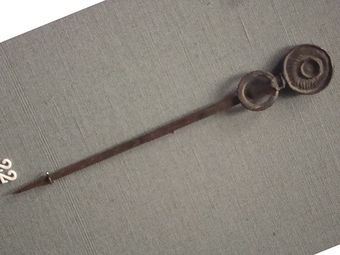
13: Large disk
Archaeology
- -
Discussion
- -
-
 Ireland

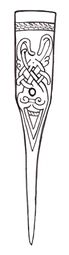
14: Wide
Archaeology
- -
Discussion
- -
-
 Type: Wide
-
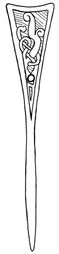 Type: Wide
-
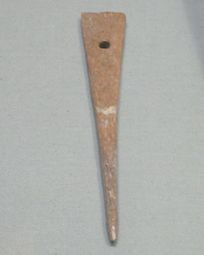 Dublin Whalebone


15: Filigree ball
Archaeology
- England, Kent: Gilton Ash
- Scotland, Ballinaby
- Denmark (old), Thunby-Bienebek (GRAHAM-CAMPBELL 1980 cat.207)
- Denmark (old), Hedeby
Discussion
- -
-
 Ballinaby
-
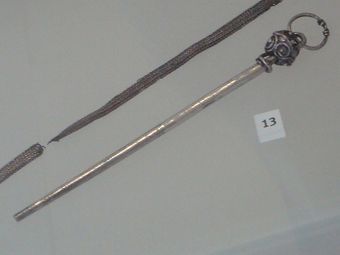 Ballinaby
-
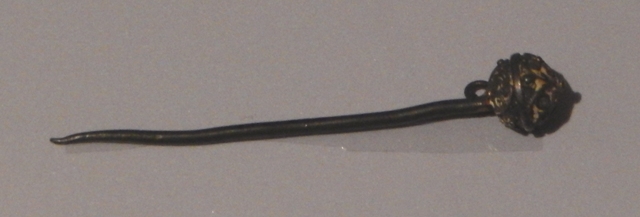 Gilton Ash
-
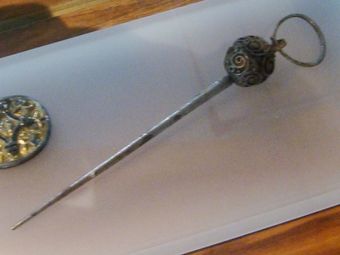 Hedeby


Shanks
Introduction
Many pins have been excavated with a bend in the shank. Halpin has put forth the theory that this may be a deliberate feature and may has assisted the pin in keeping two pieces of cloth together.
Round
--
Round with a Swelling
--
Round with a Square Section
--
Square
--


