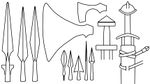
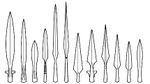
The catalogue follows Thålin groups and then subdivided by Petersen's (PETERSEN 1919) types. Winged spearheads have been ground together in their own section and also include finds from outside of Britain.
Each entry consists of the following components:
Current location- The musuem and catalogue number.
Find Type- River find, grave find or stray. Also includes any proposed period dating.
Find Date- The year that the find was discovered.
Total length- The length, width, etc of the find
Blade- The length, width, etc of the blade. Plus any published suggestions of typology.
Socket- The length, width, etc of the blade plus description of any decoration.
Comments- Any other information or opinions.
Bibliography- A list of published references.
Dimensions are given where known and can be stated in either imperial or metric measurements. Reference is sometimes made to Rygh types. Rygh’s (RYGH 1885) book illustrates examples of many pre-historic objects from Norway. These are designated as R.xxx where xxx is Rygh’s figure number.
Thålin Group 1
Leaf-shaped Spearheads (Pre 900AD) Petersen Types A-E
Group 1 consists of Petersen types A, B, C, D1 and E. They are all types with a lancoid blade and gradual transition from socket to blade.
Petersen Type A/B
Short socket with a flat, slightly raised backed, leaf shaped blade.
Petersen dates them from before the Viking Age to the start of the Viking Age.
Short socket with a leaf shaped blade, broader towards the socket.
Similar to the type D1 but with a wider blade and shorter socket. Petersen dates them to the second half of the C9th although this has now been extended to the mid C10th [Hjardar & Vike 2016: p.175]
Petersen Type D1
Long socket with a long narrow leaf shaped blade.
Similar to the type C but with a narrower blade and longer socket. Petersen discuss types D1 and D2 together and dates them to the C10th and in Norway they are found with Swords or types: S, Q, Special 20 and 1 with a type H. Also with Axe types: I-K and shields of R565.
England, Cambridgeshire: River Ouse, Braham's Farm
Current Location- Cambridge Museum of Archaeology and Anthropology Z 15993 (MAA Online Catalogue) 1929.283 (ROESDAHL 1981)
Find Type- River find.
Find Date- 1929?
Total length- L:45cm (MAA)
Blade- Max width:3.7cm (MAA). Pattern-welded. Possibly a type E (FUGLESANG 1980)
Socket- Richly ornamented with silver, copper and fragments of gold, the design being apparently a variation of the Ringerike style. (LETHBRIDGE & O'REILLY 1931)
Comments-
May be Anglo-Saxon as "there is no good parallel in Scandinavia fore the ornament on the Ouse spearhead" (Fuglesang 1980).
"I don't doubt that the spearhead... is from the 10th century and preferably the first half of this century, the silver inlay seems to show that too. It is more difficult to decide tehe origin of this spearhead. It is a well-known type in Norway, but it may very well be made by the Northmen in England." Dr Jan Petersen. (Lethbridge & O'Reilly 1931)
"The spearhead is, according to our finds, Carolingian and we should place it about 900 A.D. We have many such spearheads with side-wings, so-called Knebellanzen, but none of them has the plait ornament seen on yours." Curator of Mainz Museum (LETHBRIDGE & O'REILLY 1931).
Short socket with a subtle transition into a long leaf shaped blade.
Petersen describes the blades of this type as having 'an almost regular width' along its length and it being 'not especially pointed'. In Norway found with Swords or types: C, D, E and H. Axes of types: A, D and 1 of C. Shield boss type: R564
Angular Spearheads with Short Sockets (950-1075AD) Petersen Types D2, G & H
Group 2 consists of Petersen types D:2, G and H. They are all types with edge shoulders placed low on the blade and a short conical socket with marked narrowing below the blade.
Fuglesang includes the winged spears of Petersens type D2 in with this group as she removed wings as a determinant of typology making Petersens D2 and G types the same.
It has also been suggested by Fuglesang and Petersen that type G spearheads without wings may be of eastern origin with the majority of finds coming from Sweden and Finland. A few decorated type G spears have been found with Urnes style decoration.
Petersen Type G
A short, thick socket that usually continues partly into the blade. The blade is quite flat.
Petersen matches this type in Norway to Swords of types: R, S, Q, 2 of Y, 1 of X and 1 of AE. Axes of types: L, M. Dates to the second half of the C10th and into the C11th.
Ornamented versions of this type are mainly found in Sweden and the Baltic (PETERSEN 1919).
Petersen discuss types D1 and D2 together and dates them to the C10th and in Norway they are found with Swords or types: S, Q, Special 20 and 1 with a type H. Also with Axe types: I-K and shields of R565.
England, York
Current Location-
Find Type-
Find Date-
Total length-
Blade-
Socket-
Comments- Bronze socket of spearhead from Farnham, C11th. This type of spearhead could be considered to be an eastern (Finish) type except for this find from York and another from the British Museum.
Angular Spearheads with Long Sockets from Britain (840-1100AD) Petersen types F, I, K & M
Group 3 consists of Petersen types F, I, K & M. They are all types with a narrow blade which is often shouldered and a socket that is long, narrow and conical.
Fuglesang has studied the K & M types of spearhead that are decorated in Ringerike designs. Due to difficulty in determining the exact typology of many of these spearheads she has introduced a new K/M type that falls between those of Petersens K and M (FUGLESANG 1980).
Petersen Type F
long and thin socket ornamented with encircling ridges and depressions. The blade is widest as it joins the socket.
Found with sword types: M, L, K, H and I. Axes types: E, G and D.
Type F spearheads generally have a length of 30-60cm with most being between 50-60cm. Petersen classes this a very numerous type in Norway and dates it from the middle C9th.(PETERSEN 1919). Possibly a precursor to type I spears.
Socket- It has 6 pairs of close set rings each with a pair of rivet holes.
Comments- I consider this to be a transitional type between F and I like those from Bruhaugen in Norway (PETERSEN 1919 Fig. 16) and Sodermanland in Sweden. (BJORN & SHETELIG 1940 p.20) Edwards quotes Cowen who considers this spear as a hybrid between Petersen's type F and I.(EDWARDS 1992 P.46)
The socket commonly has 11 pairs of holes originally with bronze rivets. Some have up to 15 pairs of holes. Petersen classes these as not numerous in Norway (PETERSEN 1919).
Find Type- River find. Part of a group of 16 items including 6 type k spearheads. Dated to the early C11th.
Find Date- 1920s
Total length-
Blade-
Socket- "The socket ls decorated with an elaborate interlacing pattern, inlaid in white metal; above this, the neck of the spear has eight facets, each bearing an inlaid key pattern. The lower end of the socket is damaged. but can be to some extent reconstructed from a strikingly similar spearhead found at Hyilestad, north of Bergen in Norway."[WHEELER 1927:p.20] Wheeler identifies the decoration as Ringerike.
Comments- socket covered with alternating silver and copper chevrons.[BJORN & SHETELIG 1940:p.84] This type of decoration is known mainly from Norway.[GRAHAM-CAMPBELL 1980:p.73]
Similar to type K, but shorter, and they have the widest part of the blade further towards the tip than type K's. These date mostly to the C11th. [PETERSEN 1919] Fuglesang has redefined the difference between types K and M by measuring the distance from the mouth of the socket to the widest part of the blade (the shoulder). [FUGLESANG 1980]
Type K: 1:3 to 1:3.8
Type K/M: 1:2.4 to 1:3
Type M: 1:1.6 to 1:2.4
Scotland, Kiloran Bay, Colonsay
Current Location- National Museum of Scotland
Find Type-
Find Date-
Total length- original length:63.5cm
Blade- in more than 5 badly rusted fragments. width:6.5cm
Cambridge Museum of Archaeology and Anthropology (2015)
England, Essex, Nazeing
Current Location-
Find Type-
Find Date-
Total length- L:246mm x W:35mm
Blade- T:6mm
Socket- D:18 mm
Comments- Decoration between blade and socket consists of a barrel-shaped collar with two ribs above and below it. These had been forged by cutting into the spear when hot during manufacture. Pattern-welded blade.


.JPG)
