Sword Scabbards
...


Viking Age Compendium articles on Swords:
The Evidence
Art
The following images show help to show how scabbards of the period may have worked.
Anglo-Saxon
-
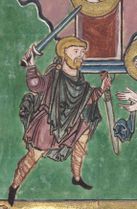 AD 971-984
BL Add. 49598 f.95v -
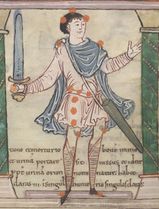 AD 1025-1050
BL Cott. Tib. B V f.39r -
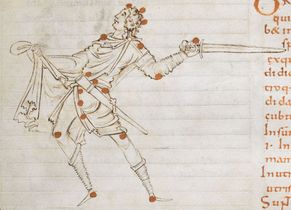 AD 980-1000
BL Harl. 2506 f.41r -
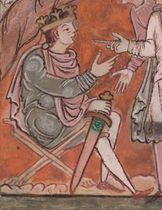 AD 1025-1050
BL Cott. Tib. B V f.85r -
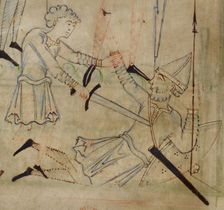 AD 1050
BL Cott. Tib. C. VI f.8v -
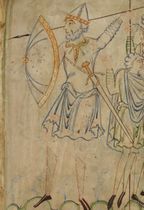 AD 1050
BL Cott. Tib. C. VI f.9r -
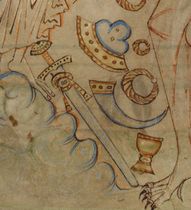 AD 1050
BL Cott. Tib. C. VI f.10v


Summary of Swords from Anglo-Saxon Manuscripts
| Manuscript | Date | Total No. of Swords |
of which are held at waist |
Total No. of Scabbards |
of which look like baldrics |
of which look like sword belts |
|---|---|---|---|---|---|---|
| BL Add. 49598 | 971-984 | 3 | 0 | 3 | 0 | 1 |
| BL Harl. 2506 | 980-1000 | 1 | 0 | 0 | 1 | 0 |
| BL Cott. Cleo. C VIII | 980-1000 | 3 | 0 | 2 | 0 | 0 |
| BL Arund. 155 | 1012-1023 | 1 | 0 | 0 | 0 | 0 |
| BL Cott. Tib. B V | 1025-1050 | 3 | 0 | 3 | 1 | 1 |
| BL Cott. Clau. B. IV | 1025-1050 | 155 | 31 | 4 | 1 | 2 |
| BL Stow. 944 | 1031 | 1 | 1 | 0 | 0 | 0 |
| BL Cott. Tib. C. VI | 1050 | 3 | 0 | 3 | 2 | 0 |
Carolingian and Ottonian
-
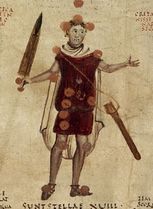 AD 800-899
BL. Harl. 647 f08r -
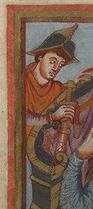 AD 849-851
BNF Lat. 266 -
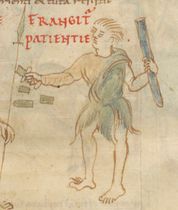 AD 800-899
BNF Lat. 8085 f059r -
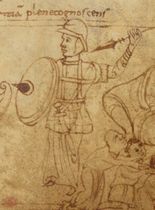 AD 800-899
BNF Lat. 8318 f060v -
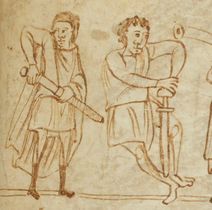 AD 800-899
BNF Lat. 8318 f062r -
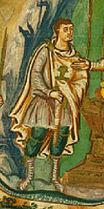 AD 869-870
Rome, San paolo -
 AD 869-870
Rome, San paolo f118v -
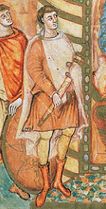 AD 869-870
Rome, San paolo -
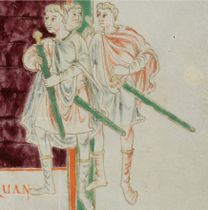 AD 883-900
St. Gallen Cod.22 039 -
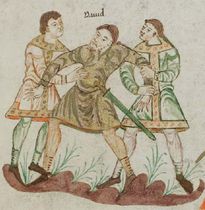 AD 883-900
St. Gallen Cod.22 075 -
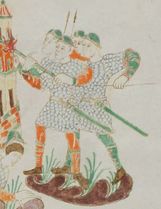 AD 883-900
St. Gallen Cod.22 141


Norman
Literature
- Words for Scabbards
- Umgerð or umgjorð – used for a complete scabbard (DAVIDSON 1962 p.187)
- Skálpr – a less frequent term to describe a bag or cover and probably refers to the leather sheath (DAVIDSON 1962 p.187)
- Skeiðir, slidrar or spænir – refer to the two wooden sides of the scabbard (DAVIDSON 1962 p.187)
- Quotes from primary evidence
Archaeology
Scabbards seem to be predominately made up of 4 layer:
- Lining -
- Core -
- Wrapping -
- Cover -
This is probably an over simplification and more information can be found in the Construction section.
England
| Location | Date | Lining | Core | Wrapping | Covering | Type | Associated Sword |
Notes | Reference |
|---|---|---|---|---|---|---|---|---|---|
| York AY17/3 (638) | fragment of leather (32cm) | - | (MACGREGOR 1982 cat.638 pp.142-143,163) (MOULD, CARLISLE & CAMERON 2003 p.3527) (CAMERON 2000 cat.219)] | ||||||
| York AY17/3 (641) | fragment of leather (17cm) | - | (MACGREGOR 1982 cat.641 p.163) (MOULD, CARLISLE & CAMERON 2003 p.3527) (CAMERON 2000 cat.217) | ||||||
| York AY17/16 (15544) | fragment of leather (19cm) | York Type 1 | - | (MOULD, CARLISLE & CAMERON 2003 p.3494) (CAMERON 2000 : cat.158) | |||||
| York AY17/16 (15545) | fragment of leather (42cm) | York Type 1 | - | (MOULD, CARLISLE & CAMERON 2003 p.3494) (CAMERON 2000 cat.186) | |||||
| York AY17/16 (15546) | fragment of leather (66cm) | York Type 1 | - | (MOULD, CARLISLE & CAMERON 2003 :p.3494) (CAMERON 2000 cat.143) | |||||
| York AY17/16 (15547) | fragment of leather (25cm) | York Type 1 | - | (MOULD, CARLISLE & CAMERON 2003 p.3494) (CAMERON 2000 cat.157) | |||||
| York AY17/16 (15548) | fragment of leather (25cm) | York Type 2 | - | (MOULD, CARLISLE & CAMERON 2003 p.3494) (CAMERON 2000 cat.154) | |||||
| York AY17/16 (15549) | fragment of leather (40cm) | York Type 3 | - | (MOULD, CARLISLE & CAMERON 2003 p.3494) (CAMERON 2000 cat.152) | |||||
| York AY17/16 (15550) | fragment of leather (38cm) | York Type 3 | - | (MOULD, CARLISLE & CAMERON 2003 :p.3494) (CAMERON 2000 cat.250) | |||||
| York AY17/16 (15837) | fragment of leather (25cm) | - | 4 fragments from possibly more than one scabbard | (MOULD, CARLISLE & CAMERON 2003 p.3513) | |||||
| York AY17/16 (15856) | fragment of leather (55cm) | - | (MOULD, CARLISLE & CAMERON 2003 p.3518) (CAMERON 2000 cat.373) | ||||||
| York AY17/16 (15894) | almost complete (70cm) | - | (MOULD, CARLISLE & CAMERON 2003 p.3528) (CAMERON 2000 cat.213) | ||||||
| York AY17/16 (15895) | fragment of leather (48cm) | - | (MOULD, CARLISLE & CAMERON 2003 p.3528) (CAMERON 2000 cat.212) | ||||||
| York AY17/16 (15896) | fragment of leather (18cm) | - | (MOULD, CARLISLE & CAMERON 2003 p.3528) (CAMERON 2000 cat.211) | ||||||
| Sommerset, Bath, Upper Borough Wall | C10th | animal hair | fragments of wood | remains of textile | fragment of leather | curved guard, probably C10th | (OWEN & DALLAND 1999 p.112) (CAMERON 2000 cat.326) | ||
| Oxfordshire, Crowmarsh | C10th / C11th | mineralised skin and hair | curved guard, probably C10th / C11th | (CAMERON 2000 cat.327) | |||||
| Gloucester, 1 Westgate Street | C9th | almost complete (78cm) | - | Opening curved (80mm wide). Seam edge/flesh stitch along the edge. Impression of a stiffener visible on the inside, the top of which is 85mm from the top. A 15mm slit is on either side of the impression. | (GOUDGE 1979 p.196) (CAMERON 2000 cat.328) | ||||
| London, Palace of Westminster | traces of oak | dated to AD 800 | (CAMERON 2000 cat.329) | ||||||
| Lincoln, Fiskerton | traces of wood | (WILSON 1965 p.33-35) (CAMERON 2000 cat.330) | |||||||
| Durham, Saddler Street | fragments of leather | butted seam on the back face | (CAMERON 2000 cat.333) | ||||||
| Derbyshire, Repton | animal hair | traces of wood | fragments of leather | (MOULD, CARLISLE & CAMERON 2003 p.3365) (BIDDLE & KJOLBYE-BIDDLE 1992) (CAMERON 2000 cat.334) | |||||
| Cumwhitton Grave 3 (901) | 16mm leather strap. Assumed to be from a baldric. | (PATERSON 2014 p.136, 232) | |||||||
| Cumwhitton Grave 4 (900) | animal hair | traces of wood | textile spiral binding over the leather cover | The textile spiral binding started at the mouth and extended 11cm down the scabbard. Trace of fine cord immediately below. Possibly English design? | (PATERSON 2014 p.136, 226, 231) | ||||
| Cumwhitton Grave 5 (880) | animal hair | traces of poplar | leather | (PATERSON 2014 p.136, 226, 231) | |||||
| Cumwhitton Grave 6 | traces of willow | textile spiral binding over the leather cover | The textile spiral binding started at the mouth and extended 8cm down the scabbard. Possibly English design? | (PATERSON 2014 p.136, 226, 231) |
Isle of Man
| Location | Date | Lining | Core | Wrapping | Covering | Type | Associated Sword |
Notes | Reference |
|---|---|---|---|---|---|---|---|---|---|
| Ballateare | AD 880-920 | textile | wood | closely woven textile | leather | Petersen Type V | (BERSU & WILSON 1966 p.52-54) | ||
|
| |||||||||
| Cronk Moar | AD 880-920 | textile | wood | closely woven textile | leather decorated with a raised moulding | Petersen Type S | [BERSU & WILSON 1966: p.72] | ||
|
| |||||||||


Scotland
- Sutherland, Balnakiel. Wooden scabbard wrapped with textile. The associated sword was probably an undercoated Petersen type H with a grip bound with horizontal binding of S-plied yarn. (BATEY & PATERSON 2012 p.637-641)
- Scar, Orkney. 2 thin laths of wood, either side of the blade and lined with sheepskin or similar. All wrapped in textile. There were no metal fittings associated with the scabbard or any evidence of a leather cover. The associated sword was probably a Petersen type H.(OWEN & DALLAND 1999 p.109-112)
Ireland
- Dublin
There are 53 fragmentary scabbards from Dublin. Two of which are nearly complete.- DLS 268 18cm remains of leather scabbard cover (AD 1050-1100). (CAMERON 2007 p.127)
- DLS 269 32cm remains of embossed leather scabbard cover (AD 1050-1100). (CAMERON 2007 p.127)
- DLS 270 27cm remains of leather scabbard cover (AD 1050-1075). (CAMERON 2007 p.127)
- DLS 271 fragments of leather cover, pelt hair and wood. Pelt hair found between two laths of wood (1.2mm thick) (AD ?). (CAMERON 2007 p.127)
- DLS 272 42cm remains of embossed leather scabbard cover (AD 1000-1100). (CAMERON 2007 p.127)
- DLS 273 44cm remains of embossed leather (calf) scabbard cover (AD 1035-1055). (CAMERON 2007 p.127)
- DLs 274 28cm remains of embossed leather scabbard cover (AD 1025-1075). (CAMERON 2007 p.127)
Denmark
- Hedeby (from the Harbour)
12 swords were recovered from the Harbour at Hedeby. 10 of these had partial remains of scabbards still attached. (HAGG 1991 p.248-268)- Sword 1 - Wooden scabbard of oak. Plied construction. Lined in animal fur. Covered in two layers of leather.
The outer horizontal top layer of wood may be of very thin wood or bast (possibly used to bind instead of textile?). The outer layer of leather has 3 diamond cut outs down its front. Two rows, 3cm apart, of decorative metal rivets was located in the area of the top mount. (HAGG 1991 p.248-257, p.265) - Sword 2 - Wooden scabbard of beech. Possible leather covering.
- Sword 3 - Wooden scabbard of alder. Plied construction.
- Sword 4 - Wooden scabbard of beech. Lined in animal fur. Bound in cloth. Covered in leather.
- Sword 5 - Wooden scabbard of beech. Lined in animal fur. Covered in two layers of leather.
- Sword 6 - Wooden scabbard of alder. Possible leather covering.
- Sword 7 - Wooden scabbard of maple. Bound in cloth.
- Sword 9 - Not enough remains.
- Sword 11 - Wooden scabbard of alder. Lined in animal fur. Covered in leather.
- Sword 12 - Wooden scabbard. Plied construction. Lined in animal fur. Bound in cloth. Covered in leather.
- Sword 1 - Wooden scabbard of oak. Plied construction. Lined in animal fur. Covered in two layers of leather.
- Hedeby (from the Graves)
Germany
- Essen Minster
- Covered in stamped gold (late C10-11th). (CAMPBELL 1982 p.171).
- Cleverns (BATEY & PATERSON 2012 p.639)
- Schortens (BATEY & PATERSON 2012 p.639)
Sweden
- Birka
35 swords have been found in graves in Birka. 30 have been a Petersen Typology and 13 have associated remains of a scabbard.- Bj.514 Wooden scabbard for a sword of Petersen type H. (ARWIDSSON 1986 p.14) (ARBMAN 1940A p.153-154, fig.102, 103)
- Bj.520 Wooden scabbard for a sword of Petersen type Y. (ARWIDSSON 1986 p.14) (ARBMAN 1940 Taf. 3:2)
- Bj.324a Wooden scabbard for a sword of Petersen type V. (ARWIDSSON 1986:P.14) (ARBMAN 1940 Taf. 3:4)
- Bj.542 Traces of a wooden scabbard for a sword of Petersen type H. (ARWIDSSON 1986 p.14) (ARBMAN 1940 Taf. 2:1)
- Bj.644 Wooden scabbard for a sword of Petersen type H. (ARWIDSSON 1986 p.14)
- Bj.736 Traces of a wooden scabbard for a sword of Petersen type H. (ARWIDSSON 1986 p.14) (ARBMAN 1940 Taf. 2:3)
- Bj.750 Wooden scabbard for a sword of Petersen type H. (ARWIDSSON 1986 p.14)
- Bj.832 Traces of a wooden scabbard for a sword of Petersen type Y. (ARWIDSSON 1986 p.14) (ARBMAN 1940 Taf. 3:1)
- Bj.834 Wooden scabbard for a sword of Petersen type X. (ARWIDSSON 1986 p.14) (ARBMAN 1940A fig. 253)
- Bj.842 Wooden scabbard for a sword of Petersen type H. (ARWIDSSON 1986 p.14)
- Bj.942 Wooden scabbard for a sword of Petersen type St ?.(ARWIDSSON 1986 p.14) (ARBMAN 1940 Taf. 1:1)
- Bj.944 Wooden scabbard for a sword of Petersen type H. (ARWIDSSON 1986 p.14) (ARBMAN 1940A fig. 321)
- Bj.957 Wooden scabbard for a sword of Petersen type H. (ARWIDSSON 1986 p.14)
France
- Saint-Denis
- (c.869) (MONTEMBAULT 1998 p.60)
Scabbard hanging styles
Swords on baldrics
Worn high on the side in a not dissimilar fashion to the Romans.
Art
- T98 BL, Cott. Tib. C vi f.8v, 9r c.1050AD

Literature
- A ‘rich baldric’ is mentioned in a Latin will dated to 867AD (DAVIDSON 1962 p.119)
- Thidriks Saga, clxxv ‘the whole scabbard (umgerð) is covered in red gold and all of the straps (fetlar) are overlaid with gold and ornamented with fine buckles (goðum sylgjum búnir)’ (DAVIDSON 1962 p.188)
- Fetill – baldric (DAVIDSON 1962 p.188)
Archaeology
- Riveted straps style Scabbards are most probably hung from baldrics. The Strap slide style scabbard is also likely to be designed to hang from a baldric.
Discussion
Swords on sword belts
--
Art
--
Literature
--
Archaeology
--
Discussion
Sword scabbards suspended from or integral to waist belts can be seen in early manuscripts but only become the dominant style in the C11th.
Scabbard Construction
Composite wooden / leather plain scabbard
A scabbard made in layers using different materials. The wooden core is usually lined on the inside with sheep shin, hair on. Over the wood is a layer of textile and then a further layer of leather, or more rarely linen, overall.
... covered in leather
--
... covered in textile
Art
- Italian wall painting – Regia site?
Literature
- Charlemagne scabbard was described by a monk of St. Gall thus “This sword was enclosed first by a scabbard, secondly by a leather of some kind, thirdly by pure white linen rendered stronger by clearest wax and strengthened towards the centre by little raised crosses for the destruction of the heathern” (DAVIDSON 1962 p.113).
Archaeology
- Sutton Hoo
- Balnakiel, Scotland
Discussion
--
All leather scabbard
Discussion
We have no evidence for scabbards without wooden cores. 'All leather' scabbards are often used by reenactors as they are deemed to be safer to fall upon.
Scabbard decoration
Gold plated
Archaeology
- A sword from Essen Minster dated to the late 10th or 11th centuries is covered in stamped gold (CAMPBELL 1982 p.171).
- The Sword of St Maurice in the Weltliches Schatzkammer, Vienna has an olive wood scabbard overlaid with panels of gold decorated with repousse figures of Kings (OAKESHOTT 1991 p.56). Dated to the second half of the 11th century Oakshott believes this to be purely a scabbard used for ceremonial occasions.
Embossed
Archaeology
- The Hiberno-Norse burial at Cronk Moar, Isle of Man had a scabbard with a leather outer decorated with a raised moulding (BERSU & WILSON 1966 p.72).
- Dublin C11th scabbards with moulding.
Incised Designs
Archaeology
- Dublin 4 scabbards with incised designs.
Decorative Seams
Archaeology
- A leather scabbard from Hedeby has 3 diamonds down its front created by two layers of leather (HAGG 1991 265)
References


- Pages transcluding nonexistent sections
- Weapons
- Arbman 1940a
- Arbman 1940
- Arwidsson 1986
- Batey & Paterson 2012
- Bersu & Wilson 1966
- Biddle & Kjolbye-Biddle 1992
- Cameron 2000
- Cameron 2007
- Campbell 1982
- Davidson 1962
- Goudge 1979
- Hagg 1991
- Hedenstierna-Jonson 2006B
- Macgregor 1982
- Montembault 1998
- Mould, Carlisle & Cameron 2003
- Oakeshott 1991
- Owen & Dalland 1999
- Paterson 2014